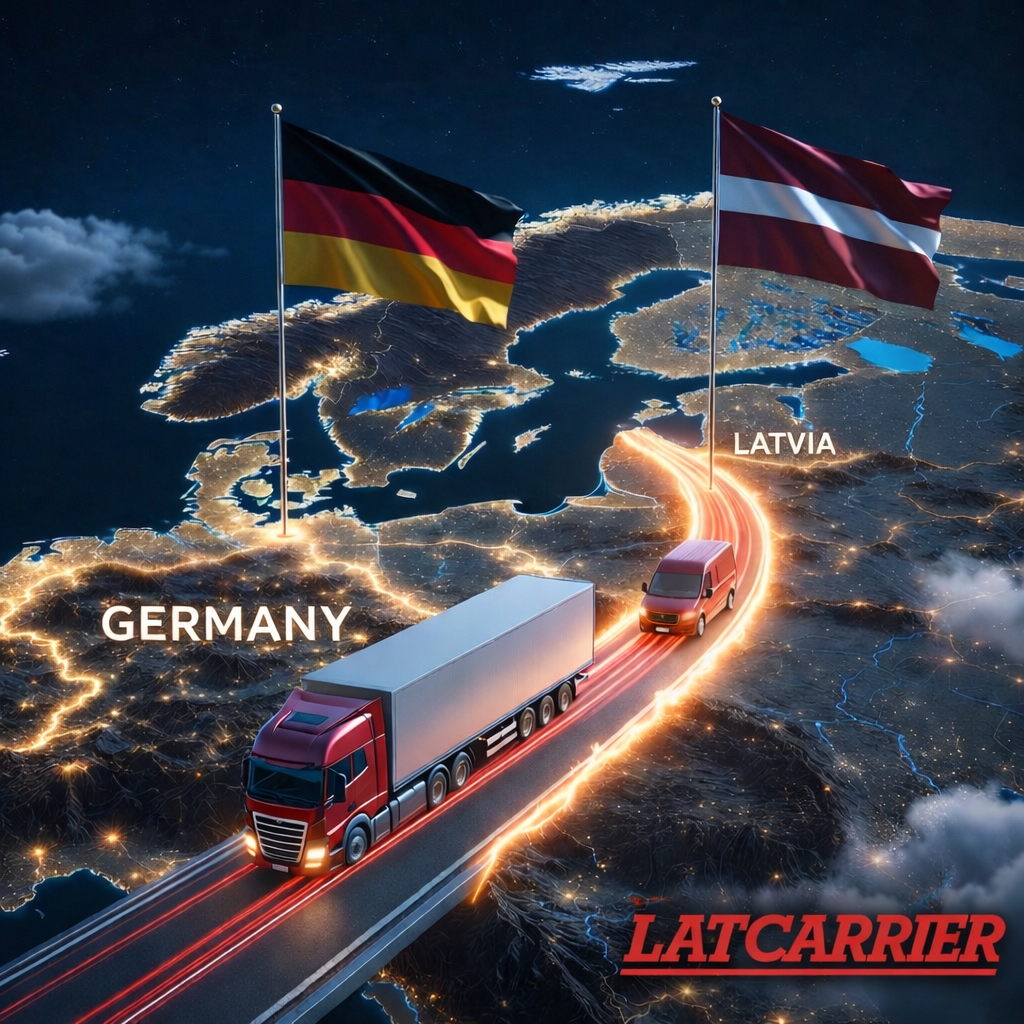
Cargo transport from Germany to Latvia is one of the most common logistics routes in Europe. German suppliers regularly ship equipment, retail goods, construction materials and industrial products to the Baltic countries. To ensure safe and timely delivery, several logistics steps must be properly organized.
Determining Cargo Parameters
Before organizing transportation, the main cargo parameters must be defined. These factors determine the type of transport, delivery time and cost.
Important information includes:
For example, transporting a single pallet weighing 300 kg requires a completely different logistics solution than shipping a 10-ton load.
Important information includes:
- cargo weight
- dimensions and volume
- number of pallets or packages
- type of cargo (goods, equipment, construction materials etc.)
- fragility or special handling requirements
For example, transporting a single pallet weighing 300 kg requires a completely different logistics solution than shipping a 10-ton load.
Choosing the Type of Transport
There are several main transportation options.
FTL (Full Truck Load) – a dedicated truck.
Suitable for large shipments that occupy most or all of the vehicle.
LTL (Less Than Truckload) – partial shipments.
Cargo is combined with other shipments in one vehicle. This option is optimal for transporting 1–5 pallets or small cargo volumes.
Express transport – used for urgent deliveries.
Choosing the correct transport type directly affects both cost and delivery time.
Preparing Cargo for Transport
One of the most common reasons for cargo damage is improper packaging. Therefore cargo must be prepared carefully before shipping.
Basic requirements include:
Poor packaging significantly increases the risk of damage during transportation.
Basic requirements include:
- strong packaging
- palletizing the cargo
- securing with stretch film or straps
- protecting corners and fragile parts
- proper cargo labeling
Poor packaging significantly increases the risk of damage during transportation.
Documents Required for Transport
Cargo transportation within the European Union typically requires several standard documents.
Main documents include:
These documents allow the carrier and the receiver to correctly identify the shipment.
Main documents include:
- CMR international consignment note
- invoice
- packing list
- loading and delivery addresses
These documents allow the carrier and the receiver to correctly identify the shipment.
Organizing the Loading Process
To ensure smooth transportation, loading details should be agreed in advance.
Important information includes:
Accurate information helps avoid delays during loading.
Important information includes:
- exact loading address
- loading date and time
- warehouse contact person
- truck access conditions
Accurate information helps avoid delays during loading.
Cargo Transportation
The distance between Germany and Latvia is approximately 1200–1800 km depending on the region. Delivery usually takes several days.
Cargo may travel in two ways:
through logistics terminals
or
via direct transport
Every additional reloading increases the risk of damage. Therefore fragile or high-value cargo is often transported with minimal handling or direct routes.
Cargo may travel in two ways:
through logistics terminals
or
via direct transport
Every additional reloading increases the risk of damage. Therefore fragile or high-value cargo is often transported with minimal handling or direct routes.
Delivery and Unloading
After the truck arrives, the receiver checks the cargo.
This typically includes:
Once the documents are signed, the cargo is considered delivered.
This typically includes:
- verifying the number of packages
- visual inspection of the cargo
- signing the CMR document
Once the documents are signed, the cargo is considered delivered.
Common Mistakes in Cargo Delivery
Several typical mistakes occur when organizing transport from Germany:
Such mistakes may lead to cargo damage or delivery delays.
- insufficient cargo packaging
- incorrect weight or dimensions in documents
- wrong transport type selection
- trying to save excessively on logistics
Such mistakes may lead to cargo damage or delivery delays.
Delivery Time from Germany to Latvia
Average delivery time depends on distance and transport type.
Typically:
Groupage shipments may take slightly longer due to cargo consolidation.
Typically:
- Northern Germany – about 2–3 days
- Central Germany – about 3 days
- Southern Germany – about 3–4 days
Groupage shipments may take slightly longer due to cargo consolidation.
Cost of Delivery from Germany
The price of transportation depends on several factors:
For this reason transportation costs are usually calculated individually.
- cargo weight and volume
- distance
- type of transport (FTL or LTL)
- urgency of delivery
- cargo characteristics
For this reason transportation costs are usually calculated individually.
Frequently Asked Questions
Can I send one pallet from Germany to Latvia?
Yes. Small shipments are transported as groupage cargo (LTL).
How many days does delivery from Germany take?
Usually 2–4 days depending on the loading location.
Can fragile cargo be transported?
Yes, if the cargo is properly packaged and secured.
Can cargo be shipped without a full truck?
Yes. Partial shipments (LTL) are used for this purpose.
Properly organized transportation allows cargo to be delivered safely and efficiently from Germany to Latvia and other Baltic countries.
