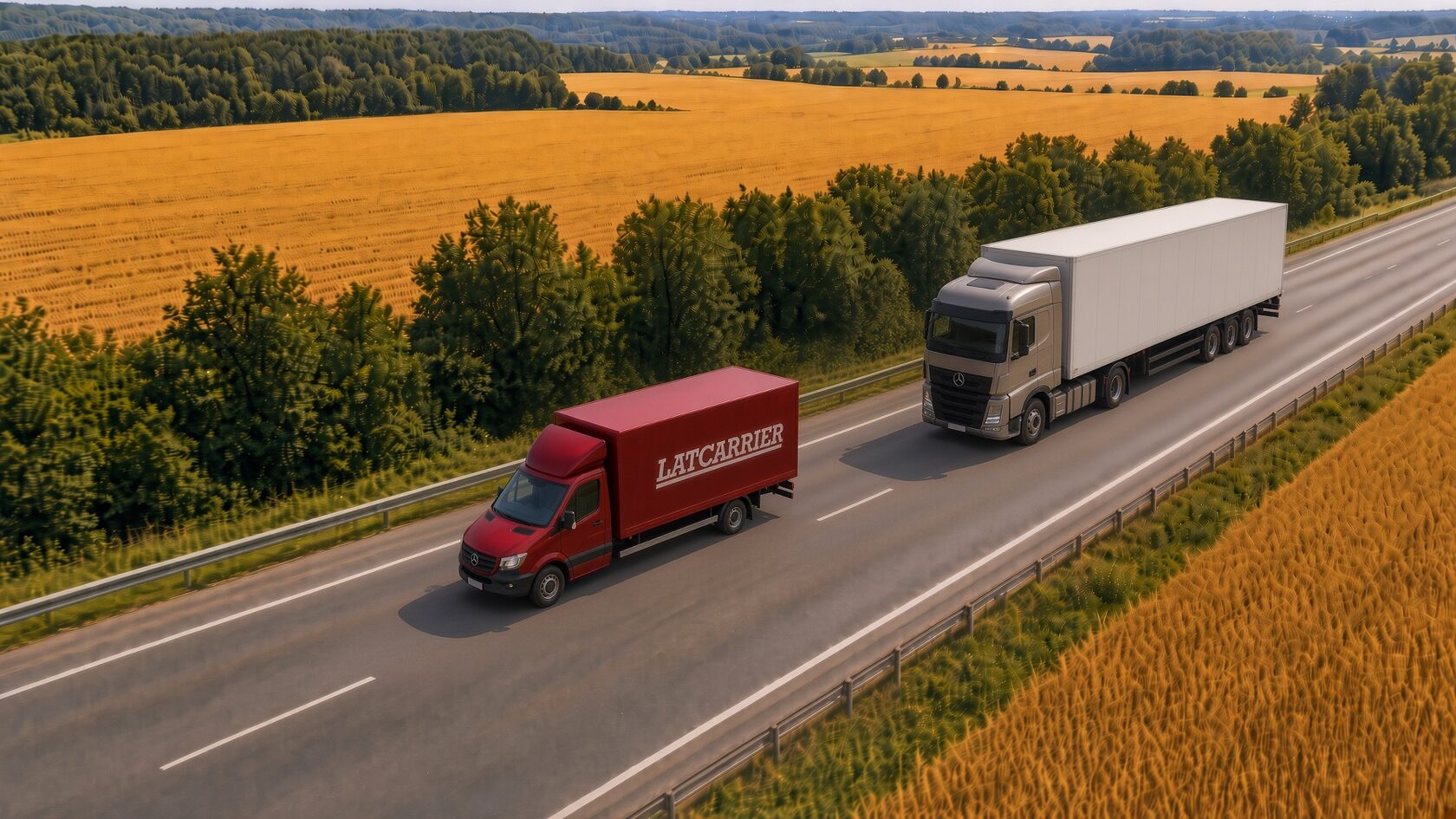
From 1 July 2026, the rules for international express freight using light commercial vehicles changed. While a small commercial van could previously travel from Germany, France or Italy to Latvia with fewer regulatory restrictions on driving time, certain express operations are now subject to EU rules on driving times, breaks and rest periods.
The main question customers are asking is: have express freight services become slower and more expensive?
Here is what has changed.
The main question customers are asking is: have express freight services become slower and more expensive?
Here is what has changed.
What Exactly Changed on 1 July 2026?
The changes are part of the European Union's Mobility Package I, including Regulation (EU) 2020/1054, which amended Regulation (EC) No 561/2006.
From 1 July 2026, EU driving time, break and rest requirements also apply to relevant vehicles or combinations of vehicles with a maximum permissible mass above 2.5 tonnes and up to 3.5 tonnes when used for international carriage of goods or cabotage.
For the relevant operations, a second-generation smart tachograph – Smart Tachograph G2V2 – is also required.
Previously, these requirements for freight transport mainly applied to vehicles above 3.5 tonnes. Their scope has now been extended to include certain light commercial vehicles.
For the express freight market, this is a significant change.
What Driving and Rest Limits Now Apply?
Drivers of vehicles covered by these requirements must comply with the EU driving, break and rest rules:
These requirements now have to be taken into account when planning many international express freight operations using light commercial vehicles.
- normally no more than 9 hours of driving per day, which may be extended to 10 hours twice a week
- after 4 hours and 30 minutes of driving, a break of at least 45 minutes is required; under the applicable rules, this may be split into 15 + 30 minutes
- no more than 56 hours of driving per week
- no more than 90 hours of driving over two consecutive weeks
- a regular daily rest period of at least 11 hours, with a reduced daily rest of at least 9 hours possible under the applicable conditions
- a regular weekly rest period of at least 45 hours, with reduced weekly rest possible under the conditions and compensation requirements established by the rules
These requirements now have to be taken into account when planning many international express freight operations using light commercial vehicles.
Does This Mean the End of Fast Delivery from Europe?
No.
Dedicated express transport remains one of the fastest ways to move cargo by road across Europe.
Its main advantage remains unchanged: cargo can be collected directly from the sender and transported towards the consignee without terminals, consolidation with other customers' freight or additional cargo handling.
What has changed is how realistic delivery times need to be calculated.
Transit time must now take into account mandatory driving, break and rest requirements for drivers covered by the rules.
The traditional idea of "one driver gets into an express van and drives to Riga as quickly as possible" therefore no longer works in the same way for vehicles covered by the new requirements.
Urgent cargo does not remove the driver's legal obligation to take the required breaks and rest.
How Can Maximum Delivery Speed Be Maintained?
For particularly urgent shipments, one possible solution is a two-driver crew.
This allows driving duties to be shared between the drivers while complying with the applicable requirements and, in certain cases, can significantly reduce overall transit time compared with a one-driver operation.
However, a two-driver solution also affects the cost of the shipment.
That is why, when booking urgent express transport, it is increasingly important to determine the priority from the beginning:
The answer may determine the entire transport solution.
This allows driving duties to be shared between the drivers while complying with the applicable requirements and, in certain cases, can significantly reduce overall transit time compared with a one-driver operation.
However, a two-driver solution also affects the cost of the shipment.
That is why, when booking urgent express transport, it is increasingly important to determine the priority from the beginning:
- minimum cost, or
- minimum delivery time.
The answer may determine the entire transport solution.
Does Every Van Under 3.5 Tonnes Need a Tachograph?
No. This is an important distinction.
It is not correct to say that every van under 3.5 tonnes requires a tachograph from 1 July 2026.
The new requirements apply to relevant vehicles and combinations of vehicles with a maximum permissible mass above 2.5 tonnes and up to 3.5 tonnes when used for international carriage of goods or cabotage.
This particular extension of the EU rules does not automatically apply to ordinary domestic transport operations.
EU legislation also provides specific exemptions for certain types of transport and circumstances.
Whether the requirements apply therefore has to be assessed according to the particular vehicle and transport operation.
Why Is Smart Tachograph G2V2 Required?
A tachograph records driver activity and enables compliance with driving, break and rest requirements to be monitored.
From 1 July 2026, relevant light commercial vehicles used for international carriage of goods or cabotage are required to use a Smart Tachograph Version 2 (G2V2).
This is therefore not simply a recommendation that transport companies should give drivers more time to rest.
These are requirements of European Union legislation, and compliance may be checked by the competent authorities.
What Has Changed for Express Freight Costs?
EU legislation does not set prices or tariffs for express freight.
However, the operating conditions for carriers have changed.
Transport planning now needs to take into account:
For this reason, comparing express freight offers only by asking "How much does the van cost per kilometre?" is now even less useful.
It is also important to understand what type of vehicle is being offered, how many drivers will operate it and whether the promised delivery time is realistically achievable in compliance with the applicable rules.
However, the operating conditions for carriers have changed.
Transport planning now needs to take into account:
- the required G2V2 tachograph for relevant vehicles
- compliance with driving, break and rest rules
- the actual amount of time one driver can legally spend driving
- the possibility of using a two-driver crew when the shortest possible transit time is required
- other requirements connected with international transport operations
For this reason, comparing express freight offers only by asking "How much does the van cost per kilometre?" is now even less useful.
It is also important to understand what type of vehicle is being offered, how many drivers will operate it and whether the promised delivery time is realistically achievable in compliance with the applicable rules.
What Should Customers Know in 2026?
The main change can be summarised simply:
Express freight has not become slow – it has become more regulated.
Dedicated transport still offers an important advantage. If a dedicated vehicle is arranged, cargo does not have to move through the standard terminal and consolidation network.
However, when an international shipment is carried by a vehicle covered by the new requirements, the route must be planned according to the applicable driving and rest rules.
This means exceptionally short delivery promises should be assessed carefully.
If one driver cannot physically cover the required distance within the promised time while complying with the mandatory rules, it is reasonable to ask the carrier:
How will this transit time be achieved – with two drivers, a different type of vehicle or another transport solution?
What Does LATCARRIER Offer?
LATCARRIER continues to arrange express freight and fast delivery from Europe to Latvia and in the opposite direction.
Following the changes from 1 July, choosing the right transport model for the specific cargo and required delivery time is particularly important.
Depending on the shipment, the solution may include:
Our goal is not simply to promise the shortest possible transit time. We aim to provide a realistic delivery time and transparent cost based on the route, cargo parameters and applicable EU requirements.
Following the changes from 1 July, choosing the right transport model for the specific cargo and required delivery time is particularly important.
Depending on the shipment, the solution may include:
- dedicated express transport
- a vehicle with one driver
- a two-driver crew for extremely urgent delivery
- another suitable type of transport
- an alternative solution where express transport does not provide an economic advantage for the customer
Our goal is not simply to promise the shortest possible transit time. We aim to provide a realistic delivery time and transparent cost based on the route, cargo parameters and applicable EU requirements.
Need Urgent Delivery from Europe?
If your cargo needs to arrive as quickly as possible, send us:
We will assess the route and propose a suitable express freight solution from Europe.
LATCARRIER – reliable logistics made simple for the customer.
- loading address
- delivery address
- cargo dimensions
- weight
- number of cargo units
- required delivery time
We will assess the route and propose a suitable express freight solution from Europe.
LATCARRIER – reliable logistics made simple for the customer.
